
English version below
Già collaboratore di Luca Ronconi e attualmente direttore artistico delle arti performative del LAC Lugano Arte e Cultura, Carmelo Rifici ha alle spalle esperienze di regie e adattamenti di tragedie greche, come per esempio la Fedra (alias Ippolito portatore di corona) di Euripide al Teatro Greco Siracusa nel 2010.
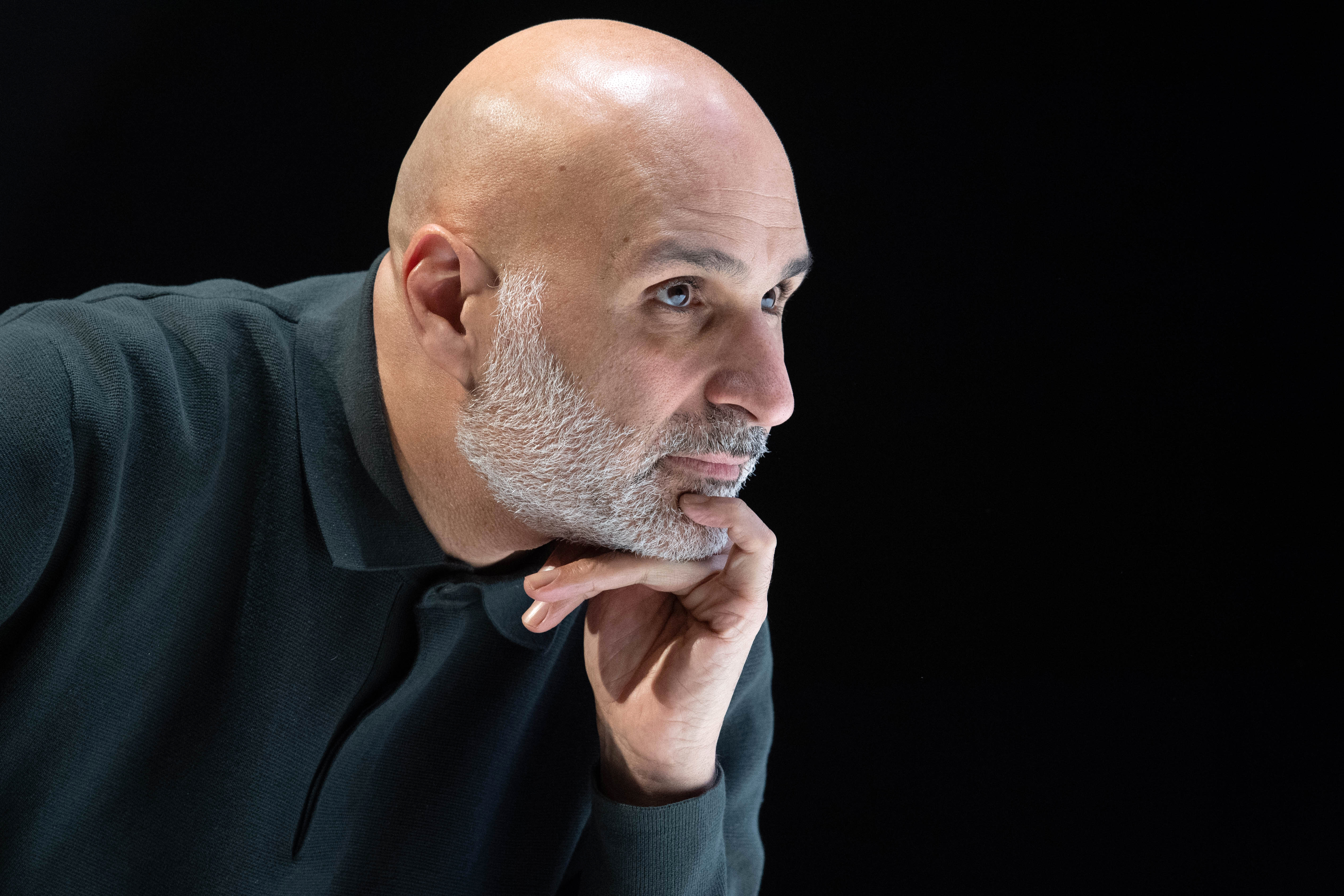 Per il 79° Ciclo di spettacoli classici al Teatro Olimpico di Vicenza è tornato alla saga degli Atridi, dopo il fortunato allestimento del 2017 intitolato Ifigenia, liberata, nel quale, a partire dalla vicenda di Ifigenia costretta alla morte sacrificale per il bene della comunità si sviluppava una riflessione sui meccanismi che da sempre inducono alla violenza e la giustificano: non soltanto gli Atridi, ma l’intero Occidente porta il fardello del sangue innocente di Ifigenia. Se per Ifigenia, liberata non vi era un testo antico a fare da guida, bensì un mosaico di riferimenti e citazioni che comprendevano Eraclito, Omero, Eschilo, Sofocle, Euripide, Antico e Nuovo Testamento, invece nel nuovo spettacolo che ha inaugurato la stagione 2026 dell’Olimpico di Vicenza al centro c’è la trilogia di Eschilo Orestea. Rifici ha articolato la messinscena in due parti distinte: intitolate rispettivamente Orestea, Mythos la prima – quella che ha esordito a Vicenza lo scorso 18 settembre, e Orestea, Logos la seconda, che verrà messa in scena successivamente.
Per un bilancio e una valutazione complessiva occorrerà attendere di assistere anche alla seconda parte, ma intanto si possono avanzare alcune osservazioni, a partire da quella che riguarda la cesura della trilogia collocata a metà circa delle Coefore, poco dopo il riconoscimento tra Elettra e Oreste e il concepimento del piano di vendetta. Naturalmente si tratta di una scelta arbitraria, dettata dalle tempistiche di durata dello spettacolo. Dopo avere visto l’intero Agamennone e l’inizio delle Coefore, nonostante siano passate due ore e un quarto, il desiderio di vedere anche il seguito è forte nello spettatore. La prassi più comune, nell’impossibilità materiale di rappresentare tutta l’Orestea, è quella di accorpare Agamennone e Coefore lasciando a sé le Eumenidi, oppure Agamennone soltanto e poi Coefore ed Eumenidi insieme. Spezzare a metà la vicenda di una tragedia lascia un po’ di amaro in bocca.
C’è anche da chiedersi quale sia la ragione del doppio titolo – Orestea, Mythos e Orestea, Logos – che parrebbe suggerire una transizione lineare dal mito alla ragione, ovvero il passaggio da un universo “mitico” (arcaico, violento, istintivo, forse dionisiaco) ad uno “logico” (razionale, riflessivo, forse apollineo), secondo lo schema reso celebre dal libro di Walter Nestle, Vom Mythos zum Logos (Stoccarda 1940). Ma questa opposizione oggi appare insufficiente per chiarire le linee di sviluppo del pensiero greco che non può essere inteso come progressivo affermarsi della razionalità critica su un sistema arcaico di credenze e simboli apparentemente irrazionali. Per quanto riguarda l’Orestea di Eschilo molte letture filologiche e filosofiche e molti allestimenti hanno seguito quello che lo studioso tedesco Anton Bierl ha battezzato “modello affermativo-evolutivo”[1], caratterizzato dall’idea di una transizione dalla barbarie alla civiltà, dall’irrazionale alla ragione, dalla notte alla luce. Ma dalle dichiarazioni d’intento di Rifici la chiave adottata per la sua nuova Orestea sembrerebbe andare in un’altra direzione. Così si è espresso il regista in una nota sul programma di sala: «È un’opera che va annoverata tra i testi sacri dell’umanità, un materiale prezioso e stratificato dell’antica sapienza greca. Lo spettacolo tenta di assecondare questa inclinazione del testo, seguendo le varie stratificazioni che il tempo gli ha concesso. Quello che ho tentato di fare è di ricercarne una verità archeologica piuttosto che farne una rappresentazione classica. Eppure, non essendo io un archeologo, né un antropologo, non posso che provare a darne una restituzione personale, nata da una immaginazione che non ha nessuna presunzione di verità, caso mai di malinconica possibilità»[2].
Di fatto Rifici ha adottato per la trilogia eschilea il medesimo approccio seguito in Ifigenia, liberata, un approccio di taglio antropologico-filosofico, in base al quale intende restituire al testo tragico il suo carattere di trauma fondativo, facendo emergere il momento in cui l’umanità scopre che la violenza non viene eliminata, bensì organizzata e istituzionalizzata, così da proporre un’analisi della fragilità della nostra concezione di giustizia. L’omicidio di Agamennone e Cassandra da parte dei nuovi tiranni di Argo (Egisto e Clitemnestra), così come il riconoscimento da parte di Elettra di Oreste quale giusto vendicatore costituiscono elementi che esprimono il trauma della civiltà occidentale, un trauma profondo dentro il quale si proiettano lo scontro tra maschile e femminile, tra patriarcato e matriarcato tra Occidente e Oriente (guerra di Troia), faida e giustizia, logica di sangue e logica di tribunale. Il nuovo ordine impone la giustizia incorporando (e non cancellando) la logica vendicativa. Trasformare queste considerazioni – alle quali non sono certo estranei René Girard, Johann Jakob Bachhofen, Emanuele Severino e anche molti altri – in uno spettacolo di movimenti, gesti e parole è un’operazione estremamente difficile. E il risultato ottenuto da Rifici è indubbiamente pregevole per l’alta qualità artistica che esprime e per l’impatto emotivo che suscita negli spettatori.
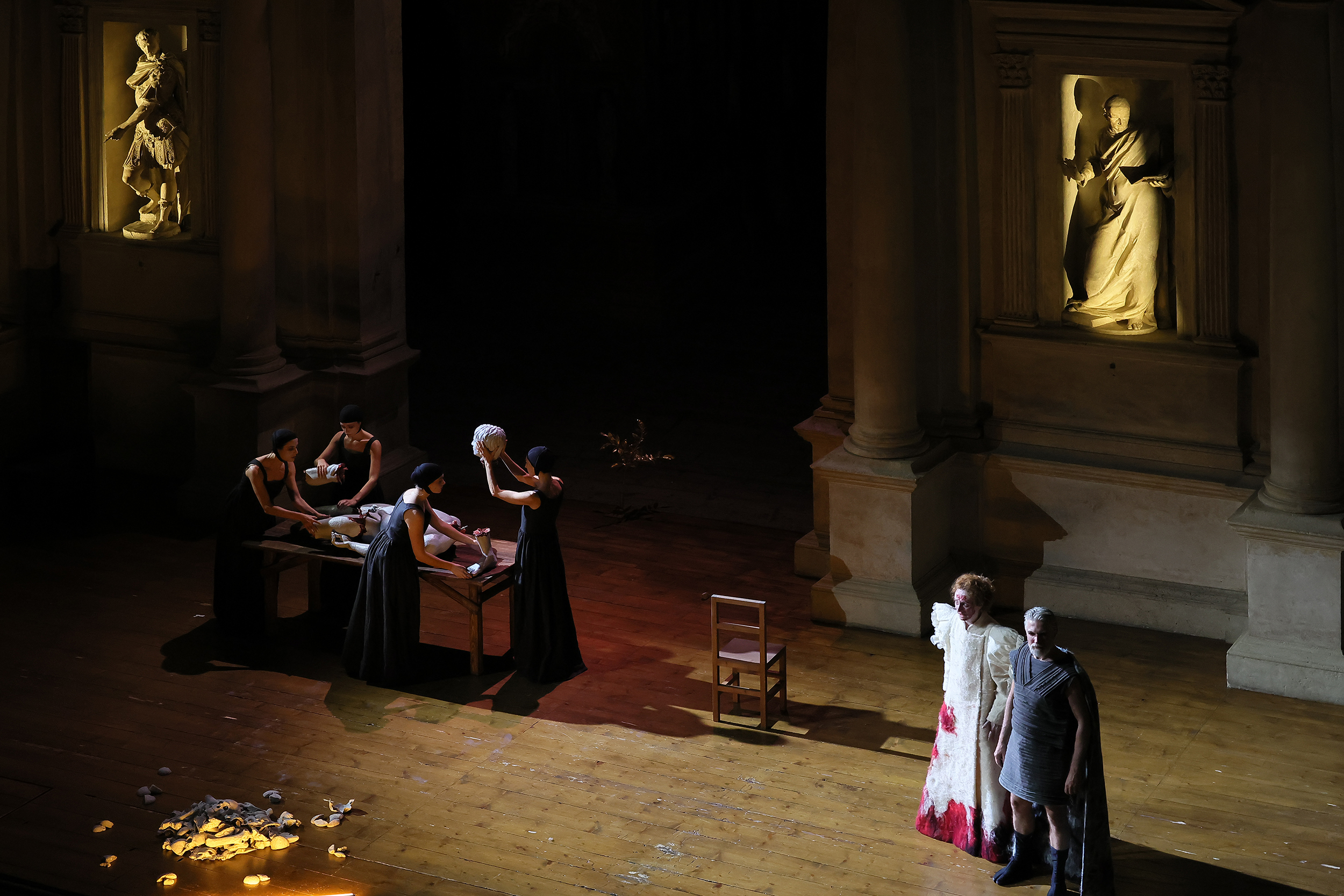
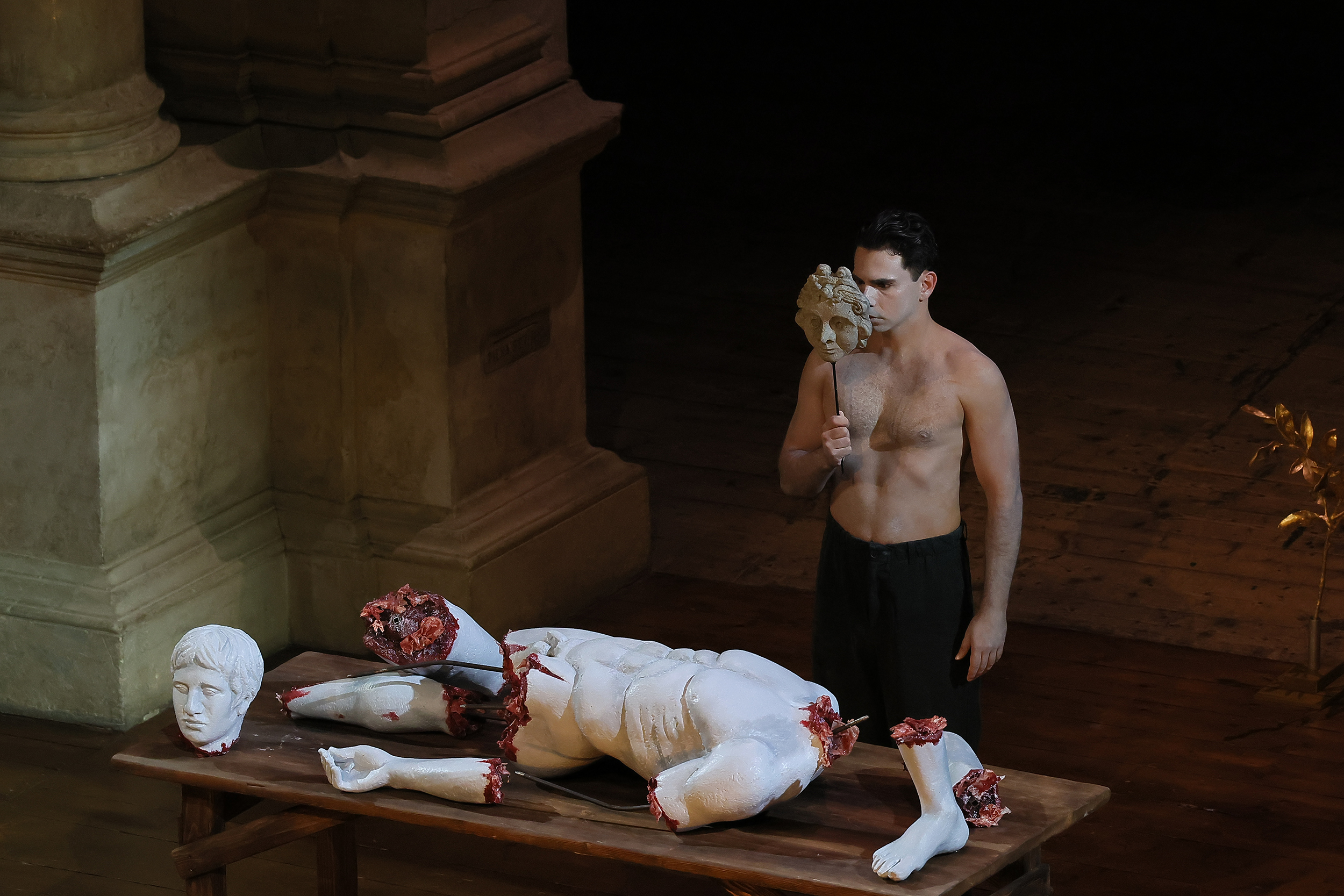
Lo spettacolo inizia col monologo della guardia notturna (Stefano Iagulli) che viene scandito fuori scena in greco antico con tono solenne, mentre sul palco un ragazzo a torso nudo resta a lungo immobile, per poi compiere dei movimenti stilizzati che imitano gesti atletici. Sul pavimento compaiono cumuli di ossa, tracce materiali dello sterminio di Troia e del sacrificio che sta alla base dell’intera vicenda mitica. Il contrasto tra questi orridi elementi scenografici e l’eleganza classica ed elegante delle decorazioni dell’Olimpico è stridente: sotto le strutture ordinate della città palladiana incombe la reminiscenza del macello. L’idea suggerita è che i resti e il sangue di bambini sacrificati – non solo Ifigenia, ma anche i figli di Tieste e tutte le vittime anonime della guerra – costituiscano lo sfondo necessario alle imprese degli eroi.
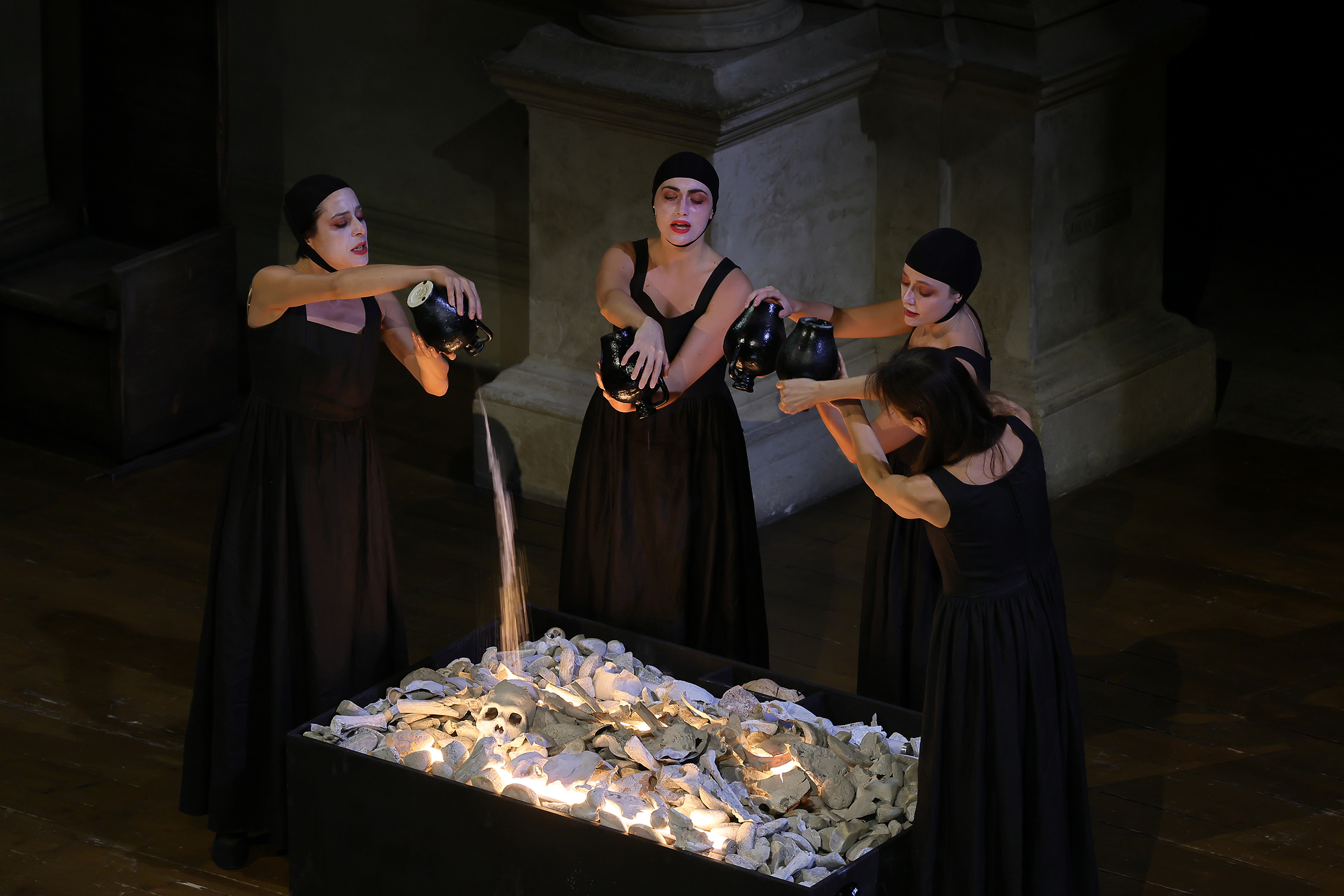
Il sacrificio di Ifigenia è rievocato dal coro, composto da figure mascherate che si muovono come marionette, e al contempo rappresentato sulla scena così da rendere icastica la reminiscenza. Agamennone arriva alla reggia su una sorta di zattera, simile a un naufrago di guerra. Non sembra affatto il sovrano trionfante che ritorna da una vittoria, ma un sopravvissuto portato a riva dalla catastrofe che ha contribuito a produrre. Fausto Cabra lo interpreta come se l’esperienza della guerra e forse i sensi di colpa per il sacrificio della figlia abbiano inciso sul suo corpo una deformazione fisica, una condizione che non può essere abbandonata neppure quando depone l’armatura. L’elmo con corna bovine e le calzature simili a zoccoli lo rendono affine all’animale sacrificale, suggerendo la continuità tra l’uomo che ordina il sacrificio e la vittima destinata a subirlo.
La Clitemnestra di Valentina Picello è la figura che meglio incarna la doppiezza dello spettacolo. All’inizio appare nuda e dorata, come una dea arcaica, una presenza autorevole e terribile. La sua forza non coincide con un generico potere femminile contrapposto a quello maschile: Clitemnestra è, nello stesso tempo, una madre ferita, una regina potente, un’assassina efferata e la custode di una memoria che il nuovo ordine vorrebbe cancellare. La sua vendetta per Ifigenia è mostruosa, ma non priva di ragioni. La messinscena suggerisce che non è possibile assolverla, ma nemmeno ridurla del tutto alla parte della colpevole. L’uccisione di Agamennone viene così preparata e consumata come un’azione sacra: la vasca da bagno diventa il luogo del sacrificio; l’ascia bipenne, strumento rituale (simbolicamente rappresentata in scena in un maxi-formato di dimensioni monumentali), restituisce al delitto una dimensione collettiva e religiosa. L’assassinio è rappresentato come il compimento di una liturgia, più che come l’esito di un’esplosione di rabbia. A Rifici non interessa la psicologia dei personaggi, quanto la forza che li attraversa e li costringe a ripetere gesti già scritti; il destino degli Atridi, in fondo, coincide con l’impossibilità di uscire dal rito.
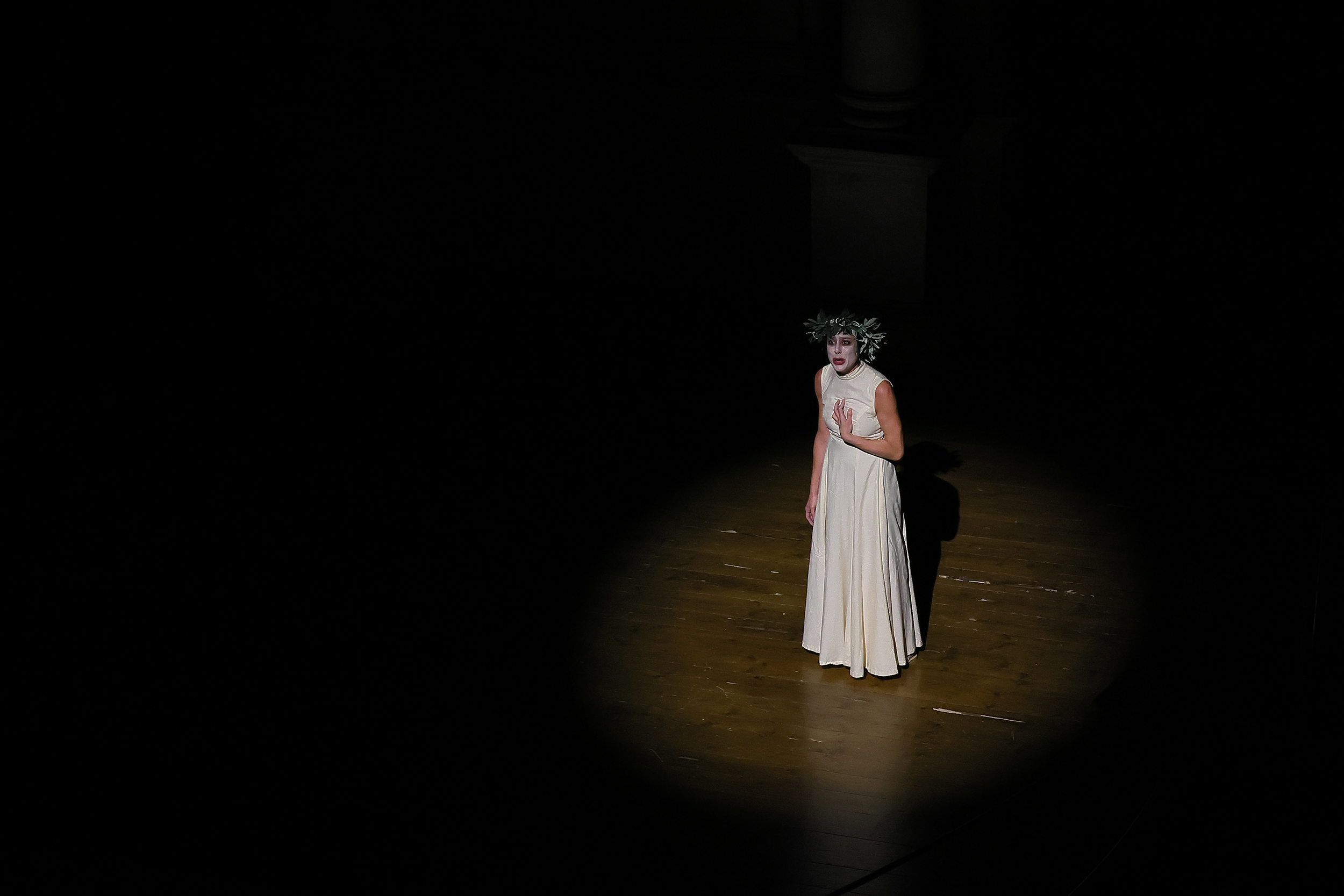
Le maschere che coprono il volto delle coreute cancellano le differenze di età e di sesso, simboleggiando un’umanità spersonalizzata. Tuttavia, nel corso dell’azione i corpi si rivelano, ed è l’attrice Giusi Merli, con la sua chioma bianca, a rivelare la dimensione degli anziani di Argo. Le altre interpreti completano una comunità che progressivamente si individualizza, come se la polis nascesse dal passaggio dal gruppo indistinto alla singola persona riconoscibile. Il coro non vuole essere l’elemento scenico che si limita a commentare l’azione: rappresenta il corpo sociale che assiste, partecipa, ricorda e giudica. Le sue voci passano dalla recitazione al canto, dalla litania al balbettio, dentro una partitura sonora composta da Federica Furlani e Zeno Gabaglio.
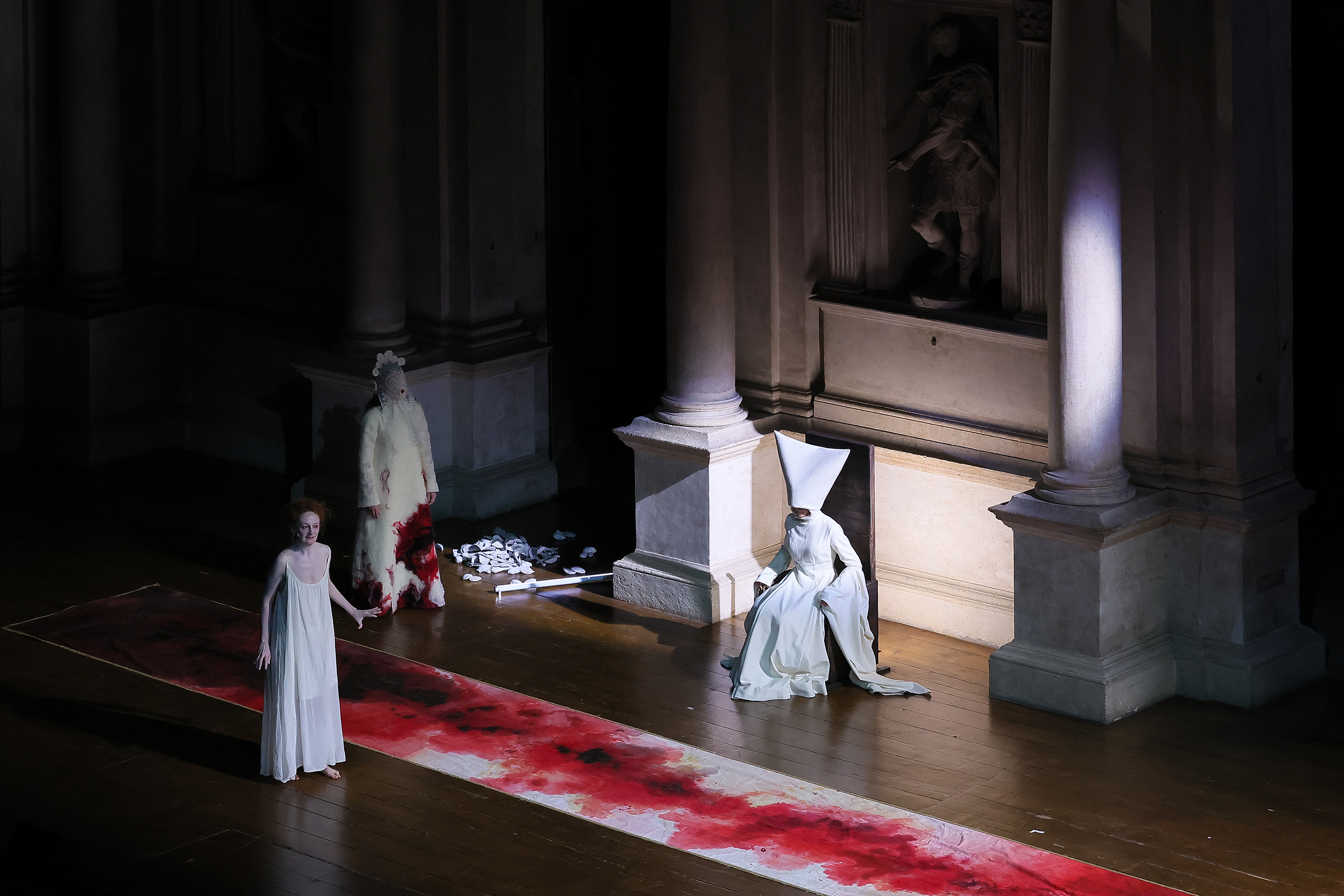
Uno dei momenti più importanti dell’allestimento è la scena di Cassandra, interpretata da Valeria Milillo. È presentata come una figura ostinata, martellante, quasi impossibile da arrestare. Indossa un immenso copricapo di foggia gotica che la rende una creatura lontana dall’umano, una presenza magica, estranea al mondo della reggia. Cassandra sa che Clitemnestra la ucciderà, sa che la reggia è una casa di morte, sa che nessuna parola potrà impedire ciò che sta per accadere. Parla per immagini perché vede il tempo come una materia simultanea: nella sua visione, il passato di Troia, il presente di Argo e il futuro dell’assassinio si sovrappongono. Evidentemente nella lettura di Rifici la profetessa troiana rappresenta il simbolo più efficace di un universo dominato dal mythos; solo più avanti il logos proverà a mettere in ordine il mondo. Cassandra è anche la figura che rivela nel modo più nitido la violenza collettiva su cui si fonda l’idea stessa di giustizia.
La cesura tra mythos e logos cade nel cuore delle Coefore, quando Oreste bussa alla porta della reggia. È il momento in cui una generazione più giovane, rappresentata da Oreste ed Elettra, entra in rapporto con il mondo arcaico senza possederne più la conoscenza diretta. Monica Piseddu costruisce un’Elettra risoluta, interamente proiettata verso il compimento dell’azione. Alfonso De Vreese dà a Oreste un’intensità più dubbiosa: il suo personaggio sembra comprendere che il compito ricevuto è necessario e insieme insostenibile. Il padre morto reclama vendetta e dalla tomba si leva fuori scena la voce profonda di Agamennone che incita i figli a compiere quella vendetta che sta scritta nel loro destino. Per liberarsi dalla brutale coazione al sangue che hanno ricevuto in eredità devono a loro volta esercitarla. È il paradosso tragico delle Coefore: per uscire dal sangue bisogna versare altro sangue.
Un aspetto meritorio della regia di Rifici sta nel sottrarre i personaggi a una recitazione psicologica tradizionale. Gli attori non costruiscono individui realistici, ma corpi attraversati da memorie, impulsi e ordini collettivi. Va detto che in qualche passaggio la densità concettuale delle idee rischia di prevalere sulla concretezza dell’azione, e la dichiarata provvisorietà di questa prima parte lascia volutamente alcuni fili sospesi. Del resto, quella che si è vista a Vicenza è soltanto la prima parte di un dittico. E bisognerà attendere la seconda per vedere come sarà proposta l’affermazione del logos, di una civiltà che impara a chiamare giustizia la propria forma di controllo della violenza. Di certo la prima parte si chiude senza alcuna promessa di conciliazione, ma con il presentimento che nessuna forma di giustizia nasca innocente e che nessun ordine riesca a cancellare completamente ciò che lo ha preceduto.
[1] A. Bierl, L’Orestea di Eschilo sulla scena moderna. Concezioni teoriche e realizzazioni sceniche, trad. di Luca Zenobi, Bulzoni, Roma 2004 (ed. or. Stuttgart-Weimar 1996), pp. 43-110.
[2] Cfr. ORÀO. Dove lo sguardo diventa scena, a cura di R. Cuppone, con la collaborazione di M. Salvatore, Teatro Olimpico Vicenza, Vicenza 2026, pp. 43-44.
Carmelo Rifici’s Oresteia: Between Mythos and Logos
Formerly an assistant to Luca Ronconi and currently Artistic Director of Performing Arts at LAC Lugano Arte e Cultura, Carmelo Rifici has extensive experience directing and adapting Greek tragedies, including Euripides’ Phaedra (Hippolytus the Crown-Bearer) at the Greek Theatre of Syracuse in 2010. For the 79th Classical Theatre Cycle at Vicenza’s Teatro Olimpico, he has returned to the saga of the House of Atreus, following the acclaimed 2017 production Ifigenia, liberate [Iphigenia, liberated]. That production, starting from the story of Iphigenia, condemned to sacrificial death for the good of the community, developed a reflection on the mechanisms that have always generated and justified violence: it is not only the House of Atreus, but the whole of Western civilisation that bears the burden of Iphigenia’s innocent blood. While Iphigenia, liberated was not guided by any single ancient text, but rather by a mosaic of references and quotations drawn from Heraclitus, Homer, Aeschylus, Sophocles, Euripides, the Old and New Testaments, and other sources, the new production centres on Aeschylus’ Oresteia. Rifici has divided the staging into two distinct parts, entitled Oresteia, Mythos – which premiered in Vicenza on 18 September – and Oresteia, Logos, which will be presented at a later date.
A comprehensive assessment will have to wait until the second part has also been seen. In the meantime, however, several observations can be made, beginning with the point at which the trilogy has been divided: approximately halfway through The Libation Bearers, shortly after the recognition scene between Electra and Orestes and the conception of their plan of revenge. This is, of course, an arbitrary choice, dictated by the running time of the production. After seeing the whole of Agamemnon and the beginning of The Libation Bearers, despite the fact that two hours and fifteen minutes have already elapsed, the spectator is left with a strong desire to see what follows. When it is materially impossible to stage the entire Oresteia, the most common practice is to combine Agamemnon and The Libation Bearers, leaving The Eumenides to stand on its own, or to stage Agamemnon alone and then bring together The Libation Bearers and The Eumenides. Splitting the story of a tragedy in two leaves a certain sense of dissatisfaction.
One may also ask why the production bears the two-part title Oresteia, Mythos and Oresteia, Logos. The title seems to suggest a linear transition from myth to reason: the passage from a “mythical” universe (archaic, violent, instinctive, perhaps Dionysian) to a “logical” one (rational, reflective, perhaps Apollonian) following the model made famous by Walter Nestle’s book Vom Mythos zum Logos [From Mythos to Logos] (Stuttgart, 1940). Yet this opposition now appears insufficient to clarify the development of Greek thought, which cannot be understood as the progressive triumph of critical rationality over an archaic system of supposedly irrational beliefs and symbols. With regard to Aeschylus’ Oresteia, many philological and philosophical readings, as well as numerous productions, have followed what the German scholar Anton Bierl has termed the “affirmative-evolutionary model”[1]. This model is characterised by the idea of a transition from barbarism to civilisation, from irrationality to reason, from darkness to light. Rifici’s statements of intent, however, suggest that his interpretation of the new Oresteia is moving in a different direction. In a note included in the programme, the director writes: “It is a work that should be counted among humanity’s sacred texts, a precious and stratified material belonging to ancient Greek wisdom. The production attempts to follow this inclination of the text, tracing the various layers that time has deposited upon it. What I have tried to do is to search for an archaeological truth rather than to offer a classical representation. Yet, since I am neither an archaeologist nor an anthropologist, I can only attempt a personal restitution, born of an imagination that makes no claim to truth, but perhaps to a melancholy possibility[2]”.
In fact, Rifici has adopted for Aeschylus’ trilogy the same approach he employed in Iphigenia, liberated: an anthropological-philosophical perspective aimed at restoring to the tragic text its character as a founding trauma. The production brings to the surface the moment when humanity discovers that violence is not eliminated, but organised and institutionalised, thereby offering an analysis of the fragility of our conception of justice. The murder of Agamemnon and Cassandra by the new rulers of Argos, Aegisthus and Clytemnestra, together with Electra’s recognition of Orestes as the rightful avenger, express the trauma of Western civilisation. Within this profound trauma are projected the conflicts between the masculine and the feminine, between patriarchy and matriarchy, between East and West – as embodied by the Trojan War – between blood feud and justice, and between the logic of blood and the logic of the courtroom. The new order establishes justice by incorporating, rather than erasing, the logic of revenge. To transform these ideas – ideas to which René Girard, Johann Jakob Bachofen, Emanuele Severino and many others are certainly not strangers – into a performance of movements, gestures and words is an extremely difficult task. Rifici’s achievement is undoubtedly remarkable, both for the high artistic quality of the production and for the emotional impact it has on the audience.
The performance begins with the monologue of the night watchman, played by Stefano Iagulli, delivered offstage in ancient Greek in a solemn tone. Meanwhile, onstage, a bare-chested young man remains motionless for a long time before beginning a series of stylised movements imitating athletic gestures. Mounds of bones appear on the floor, material traces of the destruction of Troy and of the sacrifice at the foundation of the entire mythical story. The contrast between these horrific scenic elements and the classical elegance of the Olimpico’s decorations is stark: beneath the ordered structures of Palladio’s city, the memory of slaughter looms. The suggestion is that the remains and blood of sacrificed children – not only Iphigenia, but also Thyestes’ sons and the anonymous victims of war – constitute the necessary background to the exploits of heroes.
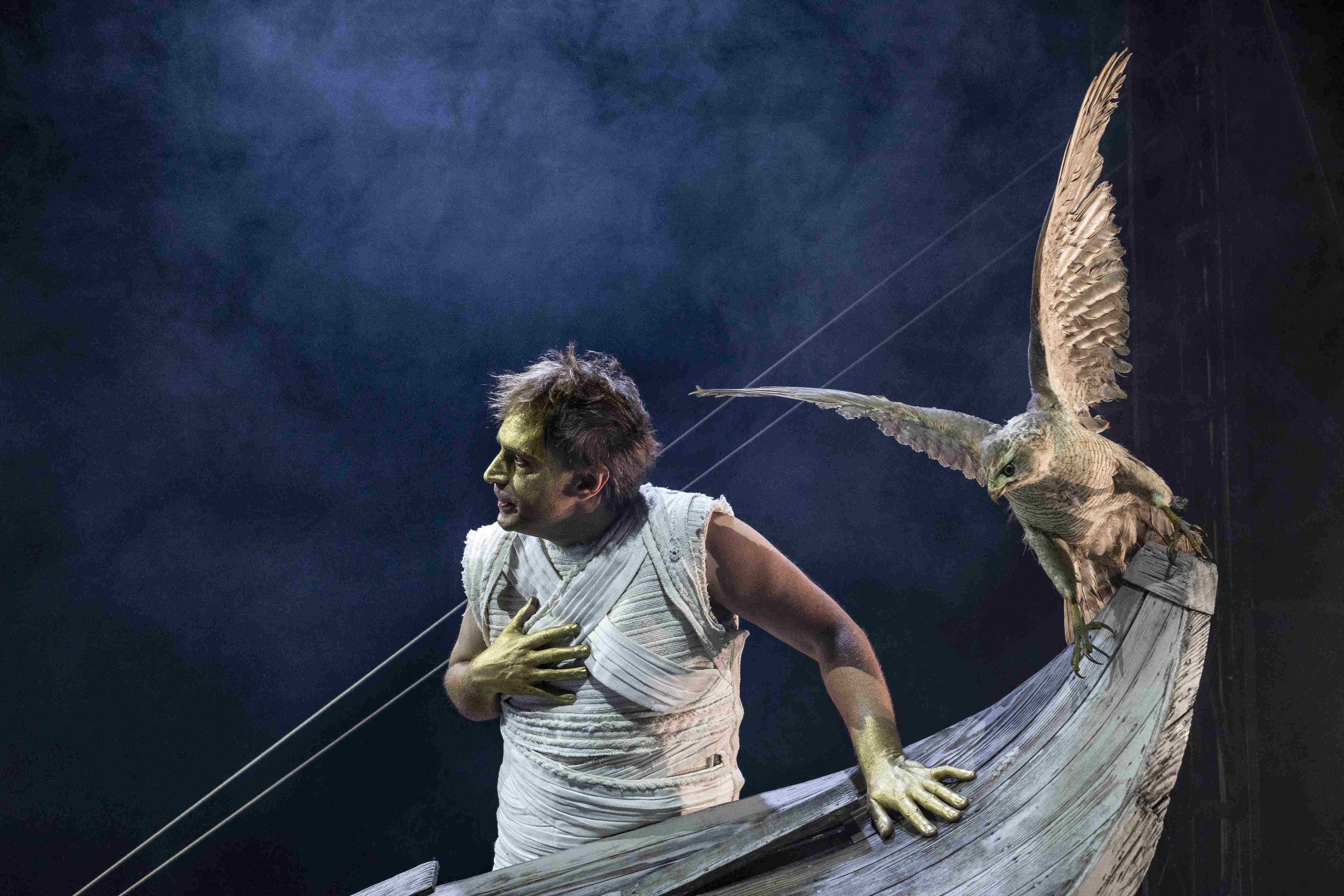
The sacrifice of Iphigenia is recalled by the chorus, composed of masked figures who move like puppets, while at the same time it is represented onstage in order to make the memory immediate and powerfully concrete. Agamemnon arrives at the palace on a kind of raft, like a shipwrecked survivor of war. He is not at all the triumphant sovereign returning from victory, but a survivor carried ashore by the catastrophe he himself helped to bring about. Fausto Cabra plays him as though the experience of war, and perhaps his guilt over the sacrifice of his daughter, had left a physical deformation imprinted on his body – a condition he cannot abandon even after laying down his armour. His helmet, fitted with bovine horns, and his hoof-like footwear make him akin to the sacrificial animal, suggesting the continuity between the man who orders the sacrifice and the victim destined to undergo it.
Valentina Picello’s Clytemnestra is the figure that best embodies the doubleness of the production. At the beginning she appears naked and gilded, like an archaic goddess, an authoritative and terrifying presence. Her power does not simply represent a generic form of female strength opposed to male power. Clytemnestra is at once a wounded mother, a powerful queen, a ruthless murderer and the guardian of a memory that the new order would prefer to erase. Her revenge for Iphigenia is monstrous, but it is not without justification. The staging suggests that she cannot be absolved, but neither can she be reduced entirely to the role of the guilty party. Agamemnon’s murder is prepared and carried out as a sacred action: the bathtub becomes the site of sacrifice, while the double-headed axe, a ritual instrument represented onstage in monumental dimensions, gives the crime a collective and religious dimension. The murder is presented as the fulfilment of a liturgy rather than as the outcome of an explosion of rage. Rifici is not interested in the characters’ psychology so much as in the force that passes through them and compels them to repeat gestures already written. The destiny of the House of Atreus ultimately coincides with the impossibility of escaping the ritual.
The masks covering the faces of the chorus members erase differences of age and gender, symbolising a depersonalised humanity. Yet, as the action progresses, the bodies are revealed, and the actress Giusi Merli, with her white hair, brings out the dimension of Argos’ elders. The other performers complete a community that gradually becomes individualised, as if the polis were born from the passage from an undifferentiated group to the recognisable individual. The chorus is not merely a scenic element whose role is to comment on the action: it represents the social body that observes, participates, remembers and judges. Its voices move from speech to song, from litany to babbling, within a sound score composed by Federica Furlani and Zeno Gabaglio.
One of the most significant moments in the production is Cassandra’s scene, performed by Valeria Milillo. She is presented as an obstinate, relentless figure, almost impossible to stop. She wears an immense headdress in a Gothic style that makes her seem alien to the human world, a magical presence foreign to the palace. Cassandra knows that Clytemnestra will kill her; she knows that the palace is a house of death; she knows that no word can prevent what is about to happen. She speaks through images because she sees time as a simultaneous substance: in her vision, the past of Troy, the present of Argos and the future of the murder overlap. In Rifici’s interpretation, the Trojan prophetess evidently represents the most effective symbol of a universe dominated by mythos; only later will logos attempt to bring the world into order. Cassandra is also the figure who most clearly reveals the collective violence on which the very idea of justice is founded.
The division between mythos and logos falls at the heart of The Libation Bearers, when Orestes knocks at the palace door. This is the moment when a younger generation, represented by Orestes and Electra, enters into contact with the archaic world without any longer possessing direct knowledge of it. Monica Piseddu portrays Electra as resolute, entirely committed to carrying out the action. Alfonso De Vreese gives Orestes a more uncertain intensity: his character seems to understand that the task imposed upon him is both necessary and unbearable. The dead father demands revenge, and from the tomb the deep offstage voice of Agamemnon urges his children to accomplish the revenge written into their destiny. In order to free themselves from the brutal compulsion to bloodshed that they have inherited, they must exercise it in turn. This is the tragic paradox of The Libation Bearers: to escape bloodshed, one must shed more blood.
One of the most praiseworthy aspects of Rifici’s direction is his refusal to reduce the characters to a conventional psychological mode of acting. The performers do not construct realistic individuals, but bodies traversed by memories, impulses and collective commands. It must nevertheless be said that, at certain points, the conceptual density of the ideas risks prevailing over the concreteness of the action, while the declared provisional nature of this first part deliberately leaves several threads unresolved. After all, what was seen in Vicenza is only the first part of a diptych. We will have to wait for the second part to see how the affirmation of logos will be presented: the emergence of a civilisation that learns to call justice its own method of controlling violence. Certainly, the first part ends without any promise of reconciliation, but with the premonition that no form of justice is born innocent and that no order can completely erase what came before it.
[1] A. Bierl, L’Orestea di Eschilo sulla scena moderna. Concezioni teoriche e realizzazioni sceniche, it. trans. by Luca Zenobi, Bulzoni, Roma 2004 (or. German ed. Stuttgart-Weimar 1996), pp. 43-110.
[2] See ORÀO. Dove lo sguardo diventa scena, ed. by R. Cuppone, in collaboration with M. Salvatore, Teatro Olimpico Vicenza, Vicenza 2026, pp. 43-44.
Orestea, Mythos di Eschilo
Traduzione: Riccardo Favaro
Drammaturgia, adattamento e regia: Carmelo Rifici
Progetto visivo: Daniele Spanò
Costumi: Margherita Baldoni
Disegno luci: Marzio Picchetti
Musica: Federica Furlani, Zeno Gabaglio
Sound design: Andrea Gianessi
Cura del movimento: Bianca Berger
Regista assistente: Ugo Fiore
Scene e attrezzeria: laboratorio «Bruno Colombo e Leonardo Richelli» del Piccolo Teatro di Milano
– Teatro d’Europa
Oggetti di scena ed effetti speciali: Valeria Desa
Costumi: Laboratorio di Sartoria del Piccolo Teatro di Milano – Teatro d’Europa
Direttore di scena e capo macchinista: Stefano Orsini
Fonico: Andrea Gianessi
Macchinista: Andrea Chianese
Elettricista: Alessandro Di Fraia
Attrezzista: Benedetta Monetti
Sarta di scena: Eleonora Terzi
Foto: Roberto De Biasio e Luca Del Pia
Produzione: LAC Lugano Arte e Cultura, in coproduzione con TPE - Teatro Piemonte Europa, La
Fabbrica dell’attore – Teatro Vascello, Piccolo Teatro di Milano – Teatro d’Europa, Teatro
Nazionale di Fiume – HNK Ivana pl. Zajca u Rijeci, partner di produzione Gruppo Ospedaliero
Moncucco
Cast: Valentina Picello (Clitemnestra), Fausto Cabra (Agamennone), Stefano Iagulli (Guardia),
Giusi Merli (corifea), Valeria Milillo (Cassandra), Monica Piseddu (Elettra), Alfonso De Vreese
(Oreste), Igor Horvat (Egisto), Francesca Osso (coreuta), Roberta Ricciardi (coreuta), Anahì
Traversi (coreuta).
Orestea, Mythos ha esordito al Teatro Olimpico di Vicenza lo scorso 18 settembre ed è stato
replicato il 19. Successivamente tornerà in scena al LAC Lugano Arte e Cultura (15-17 gennaio
2027), al Teatro Nazionale di Fiume (20-22 gennaio 2027), al Teatro Strehler/Piccolo Teatro di
Milano (26-31 gennaio 2027), al Teatro Vascello di Roma (3-17 febbraio 2027), al TPE / Teatro
Astra di Torino (17-28 febbraio 2027).