
English version below
Nel panorama del teatro italiano odierno Serena Sinigaglia ha sempre mostrato una particolare predilezione nei confronti dei classici greci. Fin dalle Baccanti del 1998, la regista milanese, diplomata alla Scuola d’arte drammatica Paolo Grassi e attualmente direttrice artistica del Teatro Carcano insieme con Lella Costa, ha manifestato un approccio creativo e intelligente al teatro antico, mettendo in scena anche Le troiane (2005), Le supplici (2022), Lisistrata (2025), e tra queste regie “greche” citerei anche l’Elektra di Hofmannsthal (2024).
Se si vogliono individuare delle linee direttive che guidano la sua interpretazione scenica di questi testi, direi che due emergono soprattutto: la dimensione corale da una parte, e la centralità del femminile dall’altra. Sono i due aspetti che caratterizzano anche l’ultimo suo lavoro, l’adattamento delle Eumenidi di Eschilo, il dramma che chiudeva la trilogia dell’Orestea, dopo Agamennone e Coefore, andata in scena ad Atene nel 458 a.C.
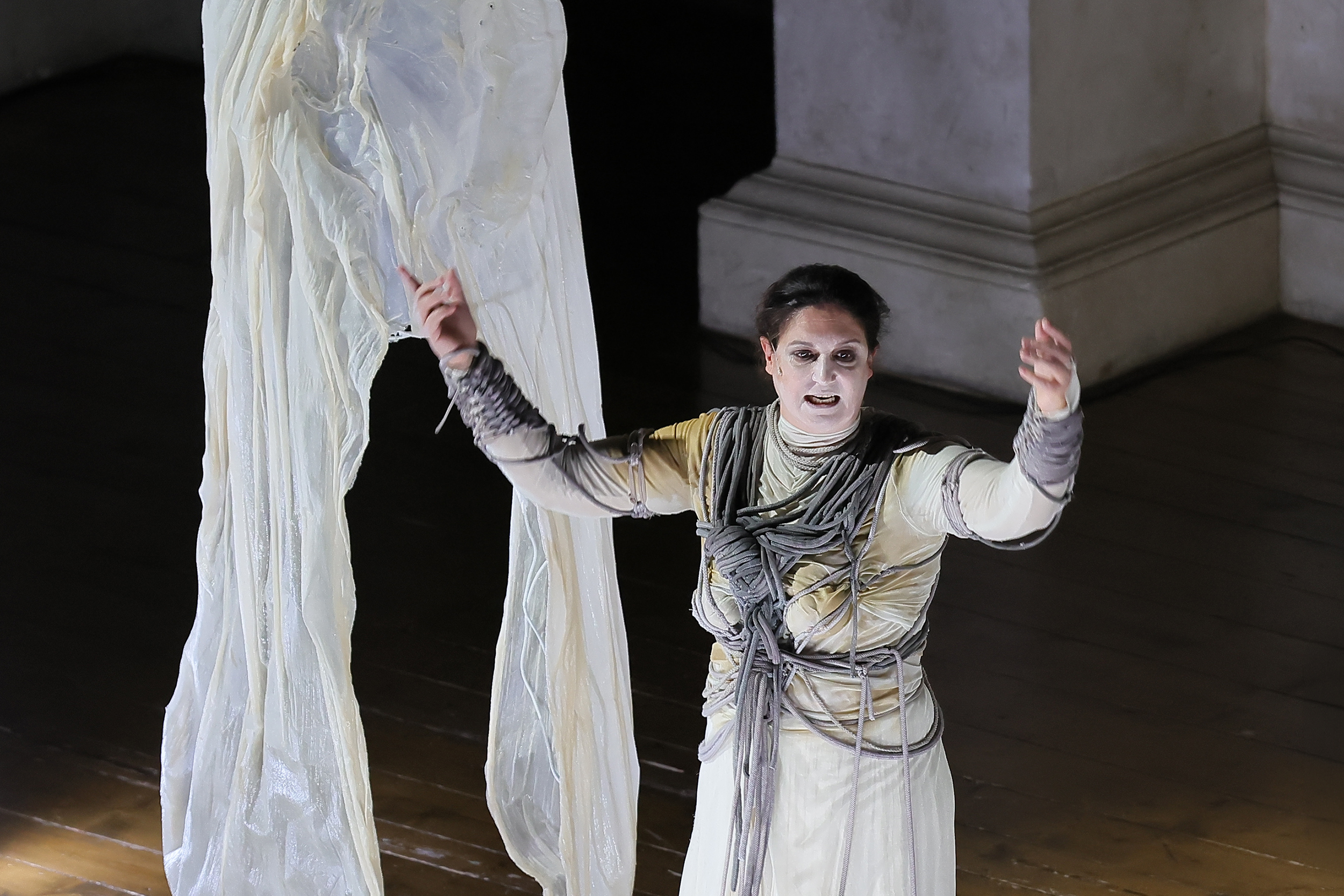
Abbiamo visto la prima dello spettacolo al Teatro Olimpico di Vicenza lo scorso 7 ottobre, nell’ambito del Ciclo di Spettacoli Classici 2026, la cui direzione artistica è affidata quest’anno a Stivalaccio Teatro. In realtà vi era stata una precedente messinscena lo scorso luglio nella Basilica di San Salvatore a Spoleto, nell’ambito del Festival dei Due Mondi, ma con un titolo diverso (Eumenidi. Oreste è salvo) e con talune differenze significative. Già il titolo scelto per Vicenza rappresenta una dichiarazione di poetica. «Tutta, tutta del Padre io sono» è la formula con cui Atena rivendica la propria appartenenza al principio paterno e la scandisce in scena subito dopo aver proclamato la sentenza dell’Areopago e aver comunicato il proscioglimento di Oreste. È una frase breve, apparentemente personale, che tuttavia contiene una precisa visione dell’ordine sociale. Atena è nata dalla testa di Zeus, senza una madre; di conseguenza, nel momento decisivo del processo a Oreste, può affermare di non riconoscersi nella genealogia materna difesa dalle Erinni. La sua dichiarazione di voto in favore del matricida, oltre a determinare l’esito della controversia giudiziaria, sancisce il passaggio da una legge fondata sul sangue e sulla memoria del delitto a una giustizia amministrata dalla città.
È proprio questo passaggio a interessare Sinigaglia. In Eschilo la vicenda conduce dal mondo oscuro e prepolitico delle Erinni alla fondazione dell’Areopago, cioè di un tribunale umano capace di sostituire alla vendetta una procedura condivisa. La regista, però, non intende celebrare questa trasformazione come un progresso lineare: il suo sguardo si concentra su ciò che la nuova giustizia lascia indietro: le divinità antiche vengono accolte nella città, ma solo dopo essere state private della loro forza originaria, addomesticate, rinominate, trasformate in Eumenidi. Il nuovo ordine non le distrugge, ma le assorbe e le integra, privandole progressivamente della loro forza.
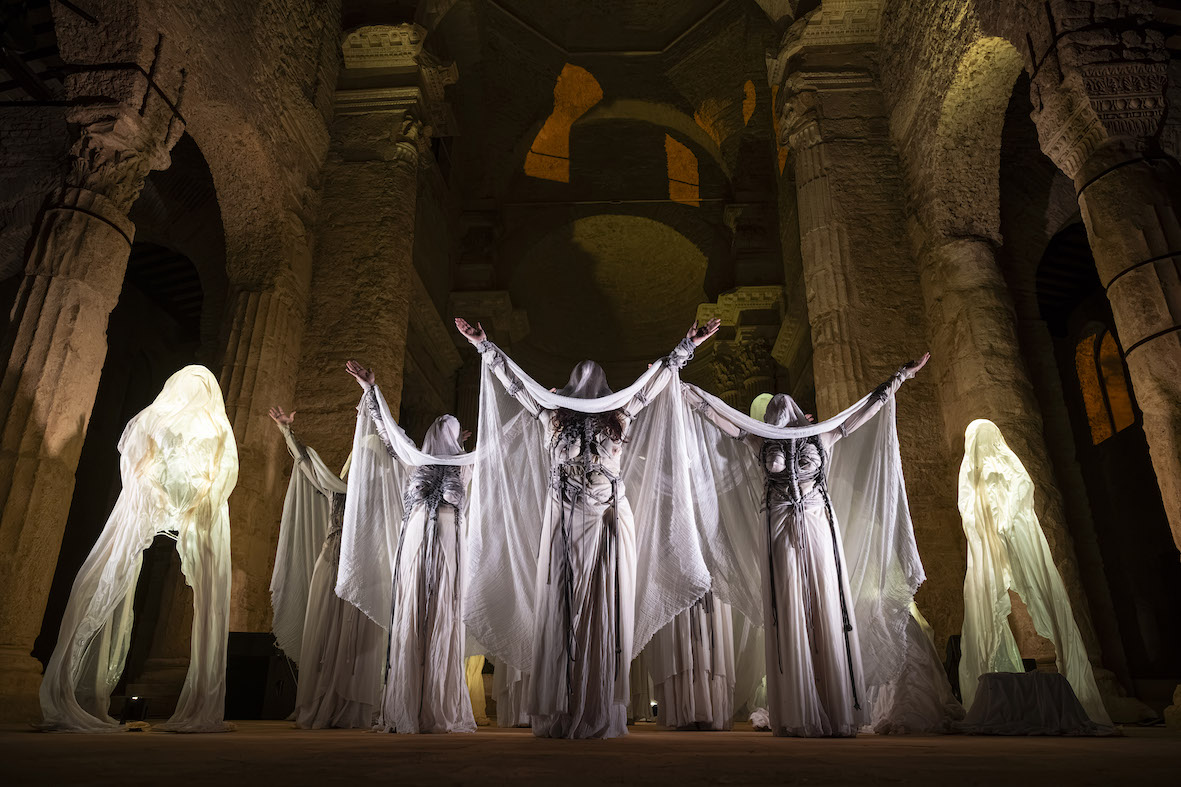
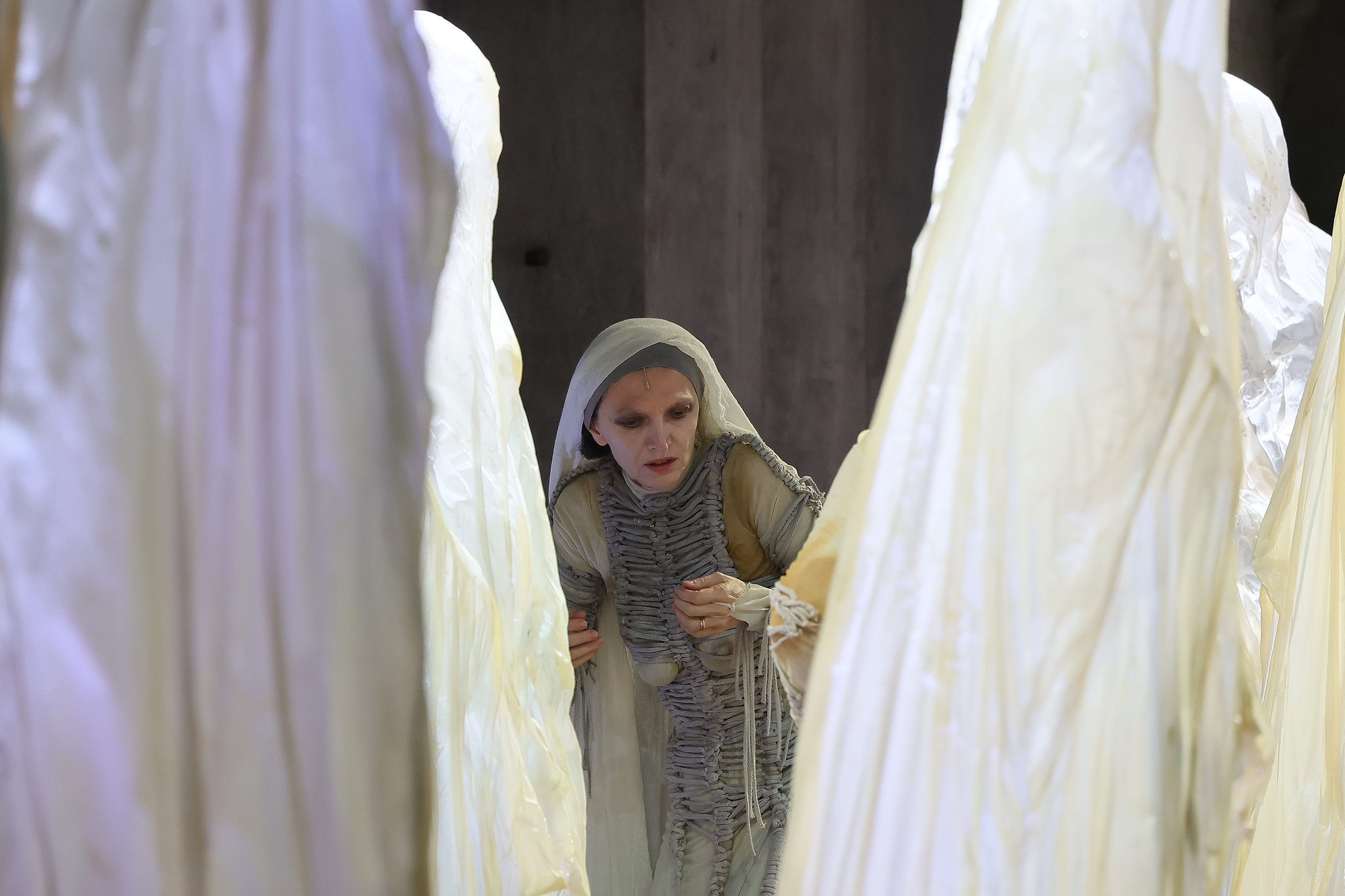
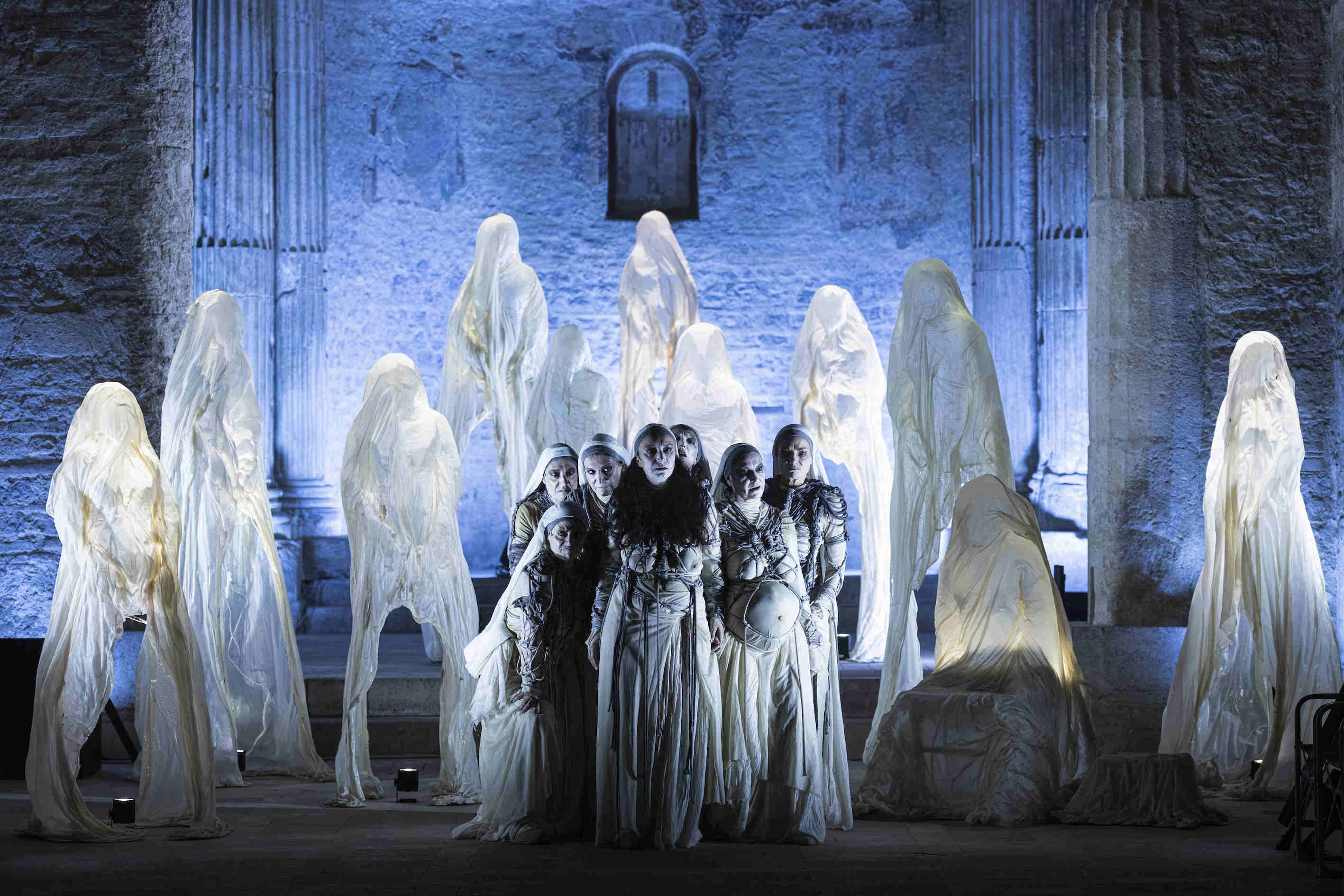
Da qui nasce il rovesciamento della prospettiva, che costituisce indubbiamente il tratto più originale di questa messinscena. Tutto è visto nella prospettiva delle Erinni-Eumenidi. In particolare, Sinigaglia parte dalle Eumenidi già pacificate, e le fa sprofondare nel proprio passato. Fin dall’inizio ce le mostra sul palcoscenico avvolte in vesti bianche drappeggiate, come ieratiche sacerdotesse, con una femminilità fortemente sottolineata anche dalla presenza di seni molto marcati, scostandosi dalle raffigurazioni canoniche che le vogliono invece nere e viscide (Peter Stein nella sua celeberrima Orestea berlinese del 1980 le immaginava come creature orrende striscianti per terra), mentre intonano canti di lode per la città di Atene, tema che corrisponde, appunto, alla conclusione del dramma. In effetti, le sette attrici che costituiscono il coro (e che interpretano via via anche i singoli personaggi) sono al tempo stesso Eumenidi ed Erinni, nel senso che fanno convivere le due nature, quella originaria e quella acquisita. La vicenda eschilea viene per così dire “decostruita”, mentre vari eventi della saga – la profezia di Calcante, il sacrificio di Ifigenia, il ritorno da Troia di Agamennone e il suo omicidio – emergono dalla memoria collettiva del gruppo come apparizioni, ricordi o incubi.
La conseguenza di questa scelta registica è che la figura di Oreste non costituisce il centro dello spettacolo. Pur rimanendo il destinatario della persecuzione e il protagonista del processo, Oreste viene osservato dall’esterno, quasi fosse il pretesto attraverso il quale le donne in scena ricostruiscono la storia di una violenza più ampia. La sua salvezza non coincide automaticamente con la salvezza della giustizia. E qui si comprende anche il cambio del titolo. Quello della messinscena di Spoleto, Oreste è salvo, aveva il tono ambiguo di una formula pronunciata dopo una sentenza. Nell’allestimento vicentino, quello definitivo, destinato a molte repliche in tournée per l’Italia, Oreste è ovviamente salvo, ma che cosa accade alle forze sconfitte? Che cosa viene salvato, davvero, quando la città decide di sostituire la vendetta con la legge? Questa è la questione posta al centro dello spettacolo.
Il dato scenico più forte dell’allestimento è l’affidamento dell’intera vicenda a sette attrici – Francesca Ciocchetti, Matilde Facheris, Maria Pilar Pérez Aspa, Arianna Scommegna, Giorgia Senesi, Sandra Zoccolan e Debora Zuin – che lavorano come un organismo unico, pur senza annullare le differenze individuali. Il loro compito non consiste tanto nel costruire personaggi psicologicamente definiti, quanto nel rendere percepibile il continuo passaggio dall’unità alla molteplicità. Una voce si stacca dal gruppo, un gesto isolato apre una scena, un corpo diventa per un momento Oreste o Clitennestra (col ventre gonfio da donna incinta mentre affronta il figlio o incalza le furie affinché vendichino la sua morte), quindi ritorna dentro il coro. La coralità non ha alcun valore decorativo, ma si fa forma del pensiero scenico. Il gruppo rappresenta la memoria del passato, ed esprime al contempo tensioni e resistenze. È una comunità che tenta di ricostruire l’origine della propria sottomissione, una sottomissione più subìta che accettata. Nella loro rievocazione ogni singolo episodio dell’Orestea è rivissuto come un frammento della progressiva cancellazione delle Erinni.
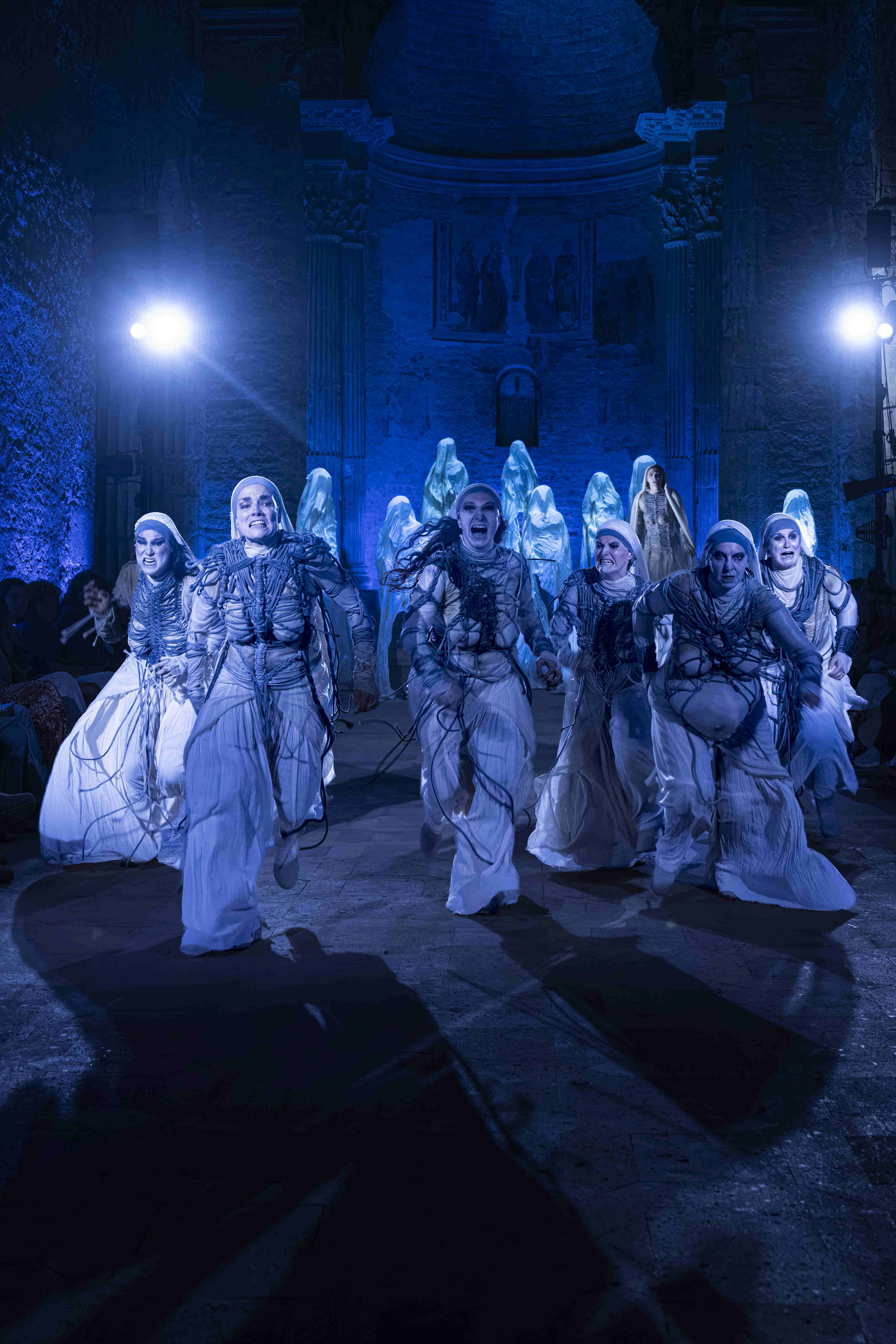
Particolarmente efficace è il lavoro sulla voce. I canti corali evocano una dimensione magico-arcaica producendo un effetto di straniamento. Allo stesso modo, le coreografie di Alessio Maria Romano conferiscono al gruppo una compattezza precisa: le attrici formano figure, si dispongono in schiere, si aggregano e si separano, dando alla scena una plasticità che richiama sia il rituale sia la disciplina militare. È significativo che lo spettacolo affronti proprio la nascita di un ordine fondato sull’autorità, ma scelga di rappresentarlo attraverso un corpo collettivo femminile.
Anche i costumi contribuiscono a questa ambivalenza. Le figure femminili appaiono sospese tra una dimensione rituale e una quasi spettrale. Le corde che attraversano e stringono i loro costumi suggeriscono vincoli e costrizioni. Quello delle Eumenidi è un corpo già disciplinato, ma nel quale la disciplina non è mai completamente riuscita, anche perché le Erinni continuano a manifestarsi sotto la superficie dell’ordine. Sinigaglia non offre una banale lettura “di genere” puntando sull’immagine idealizzata di un antico matriarcato. Le Erinni non sono affatto figure innocenti o pacificate: rappresentano una giustizia terribile, fondata sulla reciprocità del sangue e sull’impossibilità di sottrarsi alla colpa. Atena, dal canto suo, non è soltanto l’incarnazione negativa del potere maschile. La dea istituisce una nuova forma di giustizia non più affidata al ciclo infinito della vendetta, ma la nascita di tale istituzione impone un prezzo elevato: la legge cittadina si fonda su un principio che svaluta la maternità e riconosce come decisivo il legame con il padre.
Interessante è naturalmente la contraddizione che lo spettacolo mette in rilievo: è la dea Atena, una figura femminile, a legittimare un ordine patriarcale. È lei a dichiararsi, per l’appunto, “tutta” del Padre trasformando la propria eccezione genealogica (nata direttamente dalla testa di Zeus senza gestazione nell’utero materno) in principio politico. Il mito eschileo mostra in tal modo la sua attualità: i sistemi di potere non sopravvivono soltanto grazie a chi li ha fondati, ma anche grazie a chi, per necessità, interesse o desiderio di stabilità, accetta di abitarli e riprodurli. In ogni caso la regia di Sinigaglia saggiamente non cade nell’errore di chiudere questa contraddizione in una tesi univoca. La giustizia arcaica non viene presentata come una soluzione desiderabile e il nuovo ordine non viene celebrato come definitivo.
Nella nota di regia stampata sul programma di sala la regista annota tra l’altro: «Nello scontro tra Erinni e Atena si fondano i principi politici e sociali che ancora ci governano. Maschile e femminile, forze arcaiche presenti in tutti noi, padre e madre, ruoli codificati e normati, continuano a muovere il mondo. Anche se in crisi, quel sistema patriarcale fondato da Atena continua a mietere vittime e ingiustizie, ancora, dopo più di 2500 anni. Se Eschilo racconta il passaggio da Erinni a Eumenidi, noi tentiamo il percorso opposto, interrogando il mito e la storia: è esistito un tempo governato dal principio femminile? E cosa è accaduto poi? Cosa abbiamo perso? Esiste un’altra via, un’altra possibilità di “ordinare” il mondo?»
Sono domande teoriche di grande complessità e il rischio è quello di caricare uno spettacolo teatrale di speculazioni intellettuali che non gioverebbero alla rappresentazione. Serena Sinigaglia in realtà evita di dare risposte nette, privilegiando la rievocazione di episodi contenuti nella trilogia di Eschilo senza un’esplorazione radicale delle sue conseguenze politiche. C’è la storia di Agamennone, Clitennestra, Ifigenia e Oreste, ed è restituita con chiarezza e con ritmo; meno costante è la percezione del conflitto sotterraneo che dovrebbe trasformare quella storia in un’indagine sulle forme del potere. La domanda relativa a un possibile ordine femminile rimane sullo sfondo, come un presupposto teorico, e non è un male che sia così.
C’è una scena particolarmente efficace e toccante, un momento che non trova riscontro nel modello eschileo: dopo che le operazioni di voto sono state compiute, nell’attesa del verdetto che sarà proclamato da Atena, una delle coreute si toglie il velo e si presenta al pubblico come uno dei giudici scelti per l’Areopago. Tiene un discorso commosso, una sorta di parabasi tragica, nel quale esprime tutti i suoi dubbi e le sue incertezze di uomo chiamato, per la prima volta nella storia, a contribuire a una sentenza che può costare la vita ad un uomo. «C’è stato detto di giudicare, di assolvere o condannare. Ma in base a cosa decidere? Su quali punti di riferimento? Cosa vuol dire essere imparziali?». Nella sua semplicità si evidenzia qui tutta la fragilità del sistema di giudizio appena introdotto.
Alla fine di Eumenidi. Tutta, tutta del Padre io sono rimane aperta una domanda: se Oreste è salvo, da quale giustizia è stato salvato? E quale giustizia abbiamo accettato in cambio? Le Eumenidi di Serena Sinigaglia non danno una risposta, né potrebbero darla senza tradire la complessità del testo eschileo. Ci consegnano piuttosto una scena abitata da una memoria femminile che non si lascia completamente pacificare. Una memoria che continua a interrogare il momento in cui la legge nasce, e con essa la necessità – sempre ambigua – di stabilire chi abbia il diritto di parlare, chi debba essere creduto e chi, infine, possa essere accolto soltanto dopo aver smesso di fare paura.
EUMENIDI. Tutta, tutta del Padre io sono
da Eumenidi di Eschilo
Regia: Serena Sinigaglia
Adattamento drammaturgico: Serena Sinigaglia e Gabriele Scotti
Traduzione: Maddalena Giovannelli e Nicola Fogazzi
Scene: Maria Spazzi
Costumi: Emanuela Dall’Aglio
Luci: Alessandro Verazzi, Roberta Faiolo
Cori: Francesca Della Monica
Coreografie e training fisico: Alessio Maria Romano
Sound design e musiche: Lorenzo Crippa
Assistente alla regia: Elena Riccardi
Assistente alle scene: Paola Grandi
Assistente ai costumi: Ilaria Strozzi
Assistente al training fisico: Stefano Carenza
Sarte realizzatrici: Anna Gaiti e Ludovica Gavioli
Produzione: ATIR, Nidodiragno/CMC produzioni e Teatro Carcano
Cast: Francesca Ciocchetti, Matilde Facheris, Maria Pilar Pérez Aspa, Arianna Scommegna, Giorgia Senesi, Sandra Zoccolan, Debora Zuin.
Dopo una prima messinscena col titolo Eumenidi. Oreste è salvo nella Basilica di San Salvatore a Spoleto (3-5, 7-11 luglio 2026), e dopo la première al Teatro Olimpico di Vicenza (7-8 ottobre 2026), EUMENIDI. Tutta, tutta del Padre io sono andrà in scena al Teatro Sociale di Sondrio (23 ottobre 2026), al Teatro Ariosto di Reggio Emilia (10-11 novembre 2026), al Teatro Zandonai di Rovereto (12 novembre 2026), al Teatro Carcano di Milano (9-14 novembre 2026), al Teatro Fraschini di Pavia (19-21 marzo 2027), all’ Auditorium Rita Levi Montalcini di Mirandola (MO) (1 aprile 2027), al Teatro Comunale Bonifazio Asioli di Correggio (RE) (2 aprile 2027), al Teatro della Regina di Cattolica (RN) (3 aprile 2027).
“All, All My Father’s I Am”
Serena Sinigaglia’s The Eumenides
Within the contemporary Italian theatre scene, Serena Sinigaglia has always shown a particular predilection for ancient Greek drama. From The Bacchae in 1998 onwards, the Milanese director, a graduate of the Paolo Grassi School of Dramatic Arts and currently Artistic Director of Milan’s Teatro Carcano together with Lella Costa, has demonstrated a creative and intelligent approach to ancient theatre, staging The Trojan Women (2005), The Suppliants (2022), and Lysistrata (2025). Among these “Greek” productions, one should also mention Hofmannsthal’s Elektra (2024). If one wishes to identify the guiding principles underlying her interpretation of these ancient texts, two elements stand out above all: the choral dimension, on the one hand, and the centrality of the feminine, on the other. These are also the two aspects that characterize her latest work, an adaptation of Aeschylus’ The Eumenides, the play that concluded the Oresteia, following Agamemnon and The Libation Bearers, first performed in Athens in 458 BC.
We attended the première of the production at Vicenza’s Teatro Olimpico on 7 October, as part of the 2026 Classical Theatre Cycle, whose artistic direction has been entrusted this year to Stivalaccio Teatro. There had in fact been an earlier staging the previous July at the Basilica of San Salvatore in Spoleto, within the framework of the “Festival dei Due Mondi”, but under a different title – The Eumenides. Orestes Is Saved – and with some significant differences. The title chosen for Vicenza already amounts to a statement of poetics. “All, All My Father’s I Am” is the formula with which Athena asserts her belonging to the paternal principle, pronouncing it on stage immediately after announcing the verdict of the Areopagus and Orestes’ acquittal. It is a short, apparently personal sentence which nevertheless contains a precise vision of social order. Athena was born from Zeus’ head, without a mother; consequently, at the decisive moment of Orestes’ trial, she can claim not to identify with the maternal genealogy defended by the Erinyes. Her vote in favour of the matricide not only determines the outcome of the legal dispute but also sanctions the transition from a law based on blood and the memory of crime to a form of justice administered by the city.
This transition is precisely what interests Sinigaglia. In Aeschylus, the story leads from the dark, pre-political world of the Erinyes to the foundation of the Areopagus, a human tribunal capable of replacing vengeance with a shared procedure. The director, however, does not intend to celebrate this transformation as a linear form of progress. Her attention is focused on what the new justice leaves behind: the ancient divinities are welcomed into the city, but only after having been deprived of their original power, domesticated, renamed, and transformed into Eumenides. The new order does not destroy them, but absorbs and integrates them, gradually depriving them of their force.
This is the starting point for the production’s reversal of perspective, undoubtedly its most original feature. Everything is seen from the viewpoint of the Erinyes-Eumenides. Sinigaglia begins with the Eumenides already pacified and makes them sink back into their own past. From the very beginning, they appear on stage wrapped in draped white garments, like hieratic priestesses, with a strongly accentuated femininity, also emphasized by their prominent breasts. In this respect, the production departs from the canonical representations of the Erinyes as black and slimy creatures (Peter Stein, in his celebrated 1980 Berlin Oresteia, imagined them as horrifying beings crawling along the ground). The actresses sing hymns in praise of the city of Athens, a theme that anticipates the conclusion of the drama. The seven actresses who make up the chorus, and who also successively play the individual characters, are at once Eumenides and Erinyes: they bring together two natures, one original and the other acquired. The Aeschylean story is, so to speak, “deconstructed”, while various episodes from the saga – the prophecy of Calchas, the sacrifice of Iphigenia, Agamemnon’s return from Troy and his murder – emerge from the collective memory of the group as apparitions, memories, or nightmares.
The consequence of this directorial choice is that Orestes does not constitute the centre of the production. Although he remains the object of persecution and the protagonist of the trial, Orestes is observed from the outside, almost as though he were the pretext through which the women on stage reconstruct the history of a wider form of violence. His salvation does not automatically coincide with the salvation of justice. This also explains the change of title. The title of the Spoleto staging, Orestes Is Saved, had the ambiguous tone of a formula pronounced after a verdict. In the Vicenza production, the definitive version, destined for an extensive Italian tour, Orestes is obviously saved—but what happens to the defeated forces? What, in reality, is being saved when the city decides to replace vengeance with law? This is the question placed at the centre of the production.
The strongest scenic element of the production is the decision to entrust the entire story to seven actresses – Francesca Ciocchetti, Matilde Facheris, Maria Pilar Pérez Aspa, Arianna Scommegna, Giorgia Senesi, Sandra Zoccolan, and Debora Zuin – who work as a single organism without erasing their individual differences. Their task is not so much to construct psychologically defined characters as to make perceptible the constant movement from unity to multiplicity. A voice detaches itself from the group, an isolated gesture opens a scene, a body becomes Orestes or Clytemnestra for a moment – with a swollen, pregnant belly as she confronts her son or urges the Furies to avenge her death – and then returns to the chorus.
Choral performance is not decorative here; it becomes the form of the production’s thinking. The group represents the memory of the past while simultaneously expressing tensions and resistance. It is a community attempting to reconstruct the origins of its own subjugation, a subjugation that has been suffered rather than freely accepted. In their recollection, each individual episode of the Oresteia is relived as a fragment of the Erinyes’ progressive erasure.
The work on the voice is particularly effective. The choral songs evoke a magically archaic dimension, producing an effect of estrangement. Likewise, the choreography by Alessio Maria Romano gives the group a precise physical cohesion: the actresses form configurations, arrange themselves in ranks, come together and separate, lending the stage a plasticity that recalls both ritual and military discipline. It is significant that the production addresses the birth of an order founded on authority, yet chooses to represent it through a collective female body.
The costumes also contribute to this ambivalence. The female figures appear suspended between a ritual dimension and an almost spectral quality. The ropes that cross and tighten their garments suggest bonds and restraints. The Eumenides’ bodies are already disciplined bodies, yet the process of discipline has never been entirely completed, since the Erinyes continue to manifest themselves beneath the surface of order. Sinigaglia does not offer a simplistic gender-based reading by focusing on an idealized image of an ancient matriarchy. The Erinyes are not innocent or pacified figures at all: they represent a terrible form of justice, founded on the reciprocity of blood and on the impossibility of escaping guilt. Athena, for her part, is not merely the negative embodiment of masculine power. The goddess establishes a new form of justice no longer entrusted to the endless cycle of vengeance. Yet the creation of this institution comes at a high price: civic law is founded on a principle that devalues motherhood and recognizes the paternal bond as decisive.
The contradiction highlighted by the production is therefore particularly significant: it is the goddess Athena, a female figure, who legitimizes a patriarchal order. She is the one who declares herself, precisely, “all” her Father’s, transforming her genealogical exception – born directly from Zeus’ head, without gestation in a mother’s womb – into a political principle. The Aeschylean myth thus reveals its contemporary relevance: systems of power survive not only through those who founded them, but also through those who, out of necessity, self-interest, or a desire for stability, accept the terms on which they are organized and reproduce them. In any case, Sinigaglia’s direction wisely avoids reducing this contradiction to a single thesis. Archaic justice is not presented as a desirable solution, while the new order is not celebrated as definitive.
In the director’s note printed in the programme, Sinigaglia writes: “In the conflict between the Erinyes and Athena lie the political and social principles that still govern us. Masculine and feminine, archaic forces present in all of us, father and mother, codified and regulated roles, continue to shape the world. Even though it is in crisis, the patriarchal system established by Athena continues to claim victims and produce injustice, more than 2,500 years later. If Aeschylus describes the transition from Erinyes to Eumenides, we attempt the opposite journey, questioning myth and history: did a time exist when the feminine principle governed? And what happened afterwards? What did we lose? Is there another way, another possibility of ‘ordering’ the world?”
These are theoretically complex questions, and there is a risk that a theatrical production may become overloaded with intellectual speculation that would not serve the performance. In practice, Serena Sinigaglia avoids providing clear-cut answers, choosing instead to privilege the recollection of episodes from Aeschylus’ trilogy without undertaking a fully radical exploration of their political consequences. The story of Agamemnon, Clytemnestra, Iphigenia, and Orestes is presented with clarity and rhythm; less consistently perceptible, however, is the underlying conflict that should transform this story into an investigation of the forms taken by power. The question of a possible feminine order remains in the background, as a theoretical premise, and this is not necessarily a weakness.
There is one particularly effective and moving scene, an episode with no equivalent in Aeschylus’ original: after the voting has taken place, while waiting for the verdict to be announced by Athena, one of the chorus members removes her veil and presents herself to the audience as one of the judges selected for the Areopagus. She delivers an impassioned speech, a sort of tragic parabasis, in which she expresses all the doubts and uncertainties of a man called, for the first time in history, to participate in a verdict that may cost another man his life. “We have been told to judge, to acquit or condemn. But on what basis should we decide? What points of reference should guide us? What does it mean to be impartial?” In its simplicity, the scene reveals the fragility of the newly established system of judgement.
At the end of The Eumenides. All, All My Father’s I Am, a question remains open: if Orestes is saved, from which justice has he been saved? And which form of justice have we accepted in exchange? Serena Sinigaglia’s The Eumenides does not offer an answer, nor could it do so without betraying the complexity of Aeschylus’ text. Instead, it gives us a stage inhabited by a feminine memory that refuses to be completely pacified: a memory that continues to question the moment at which law is born, and with it the ever-ambiguous necessity of determining who has the right to speak, who is to be believed, and who may finally be admitted only after ceasing to inspire fear.
The Eumenides. All, All My Father’s I Am
Based on Aeschylus’ The Eumenides
Director: Serena Sinigaglia
Dramaturgical adaptation: Serena Sinigaglia and Gabriele Scotti
Translation: Maddalena Giovannelli and Nicola Fogazzi
Set design: Maria Spazzi
Costumes: Emanuela Dall’Aglio
Lighting: Alessandro Verazzi and Roberta Faiolo
Choral direction: Francesca Della Monica
Choreography and physical training: Alessio Maria Romano
Sound design and music: Lorenzo Crippa
Assistant director: Elena Riccardi
Assistant set designer: Paola Grandi
Assistant costume designer: Ilaria Strozzi
Assistant physical-training director: Stefano Carenza
Costume makers: Anna Gaiti and Ludovica Gavioli
Production: ATIR, Nidodiragno/CMC Produzioni, and Teatro Carcano
Cast: Francesca Ciocchetti, Matilde Facheris, Maria Pilar Pérez Aspa, Arianna Scommegna, Giorgia Senesi, Sandra Zoccolan, and Debora Zuin.